


The scripts and programmes listed here are continuously modified and improved as part of active research projects. The focus of development is on research and thus adaptive parameter-based input options with limited user-friendliness. If you are interested in using them, please contact the relevant contact persons for the respective content.
Subject areas
Microscopic and mesoscopic modelling
A multi-scale simulation approach enables the evaluation of different levels of detail of a fibre composite material and thus a virtual predictive forecast of the material and component behaviour. This allows empirical investigations to be reduced to a minimum.
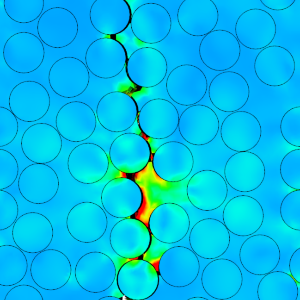
The mechanical behaviour of fibre-reinforced plastic composites is highly dependent on their microstructure due to the heterogeneity of the material. The finite element method is ideal for making predictive statements about the expected behaviour. The IFB has therefore developed a pre-processor that can be used to automatically generate realistic microstructure models of fibre-reinforced plastic composites. These can then be used to virtually determine stiffness and strength.
In addition, the generated models can be exported to the CFD programme OpenFOAM and examined in terms of permeability, pressure distribution, flow peaks and non-infiltrated areas. The variation in filament orientation, filament clustering and variation in filament cross-sections are particularly important here.
|
|
|
Contact: Simon Thissen
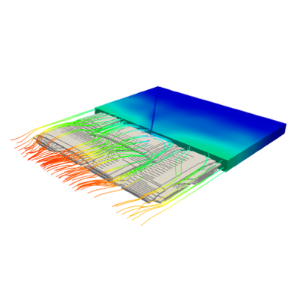
In order to numerically determine the infiltration behaviour of textiles using CFD programmes (such as OpenFOAM, FlowTex, etc.), it is necessary to generate realistic voxel volume models. The institute's own fibre bundle and textile modelling programme VOxCO is used to convert shell element-based fibre bundle paths from FEM process simulations (e.g. braiding or draping simulations) into such a model. This is based on an STL file containing the fibre bundle paths for generating realistic fibre cross-sections. The fibre bundle cross-section shape is specified by the user and constructed iteratively by the programme. The influence on computing speed, discretisation time and working memory requirements is determined and a recommendation is given for future simulations. The programme generates a uniform, structured, hexagonal computational mesh and assigns the respective cells of the uniform mesh to the existing STL textile architecture.
The CompacToFlow extension makes it possible to export compacted RVE models into a voxel format that can be read by FlowTex. This enables flow simulations and permeability determinations to be carried out using FlowTex.
|
|
|
Ansprechpartner: Simon Thissen
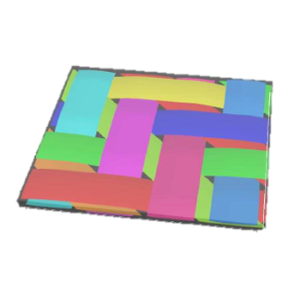
The TexGen BraidExtension tool was developed at the institute to generate biaxial and triaxial braided RVEs in the TexGen programme. In this Matlab/Python script, several textile parameters (including yarn width, height, spacing, RVE dimensions, braiding angle) can be specified as user input. The programme then generates a TexGen model that can be visualised and modified in TexGen. In addition, the permeability of the braid models created is calculated analytically. No compaction function for braids has been implemented yet, but this can be added if there is interest.
|
|
|
Contact: Simon Thissen
Structural evaluation
An automated process chain for geometric and structural-mechanical evaluation enables rapid assessment of geometries with regard to various application scenarios.
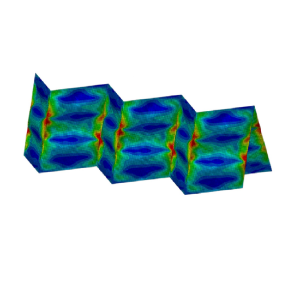
The use of folded core materials for sandwich materials allows for a high degree of design freedom thanks to the wide range of fold geometries that can be implemented. In order to evaluate the large number of different geometries, a numerical process chain was developed at the IFB that evaluates the mechanical properties of the folded cores in an automated process. This includes the generation of the corresponding geometries, transfer to a selected FE solver and post-processing. In addition, an interface to a database was implemented to provide the necessary data for manufacturing and simulation. An integrated optimisation environment facilitates the rapid evaluation of geometries with regard to specific application scenarios.
|
|
|
Ansprechpartner: Simon Thissen
Tools for production optimisation
The manufacture of a fibre composite component requires an estimate of the necessary production materials and costs. The actual costs depend on the manufacturing technologies used.
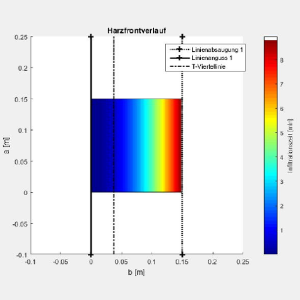
The manufacture of a fibre composite component using the VARI/VAP process requires an estimate of the necessary manufacturing materials and costs. The developed programme enables this by entering the dimensions and the desired fibre volume content of a component. Here, the amount of matrix remaining in the structure is specified depending on the hose length and size of the component. In addition, the programme provides recommendations for different sprue variants to enable complete infiltration.
|
|
|
Ansprechpartner: Simon Thissen
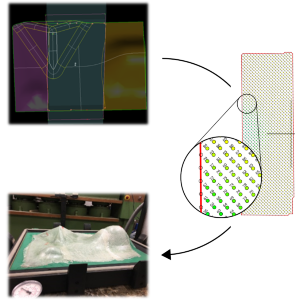
The FormPatch project developed a method for the automated generation of fibre semi-finished patch geometries for the optimal coverage and moulding of component geometries. This method was implemented in the open source software application OpenCascade and expanded to include interactive kinematic draping simulation. Publication: https://doi.org/10.1016/j.promfg.2020.04.143
|
|
|
Ansprechpartner: Simon Thissen
General contact person

Michael May
Dr.Deputy Head of Department Lightweight Design & Simulation